
Strategic Expenditure (StratEx)
Strategic Expenditure (StratEx)
Moving Beyond CapEx vs OpEx
What Is Strategic Expenditure?
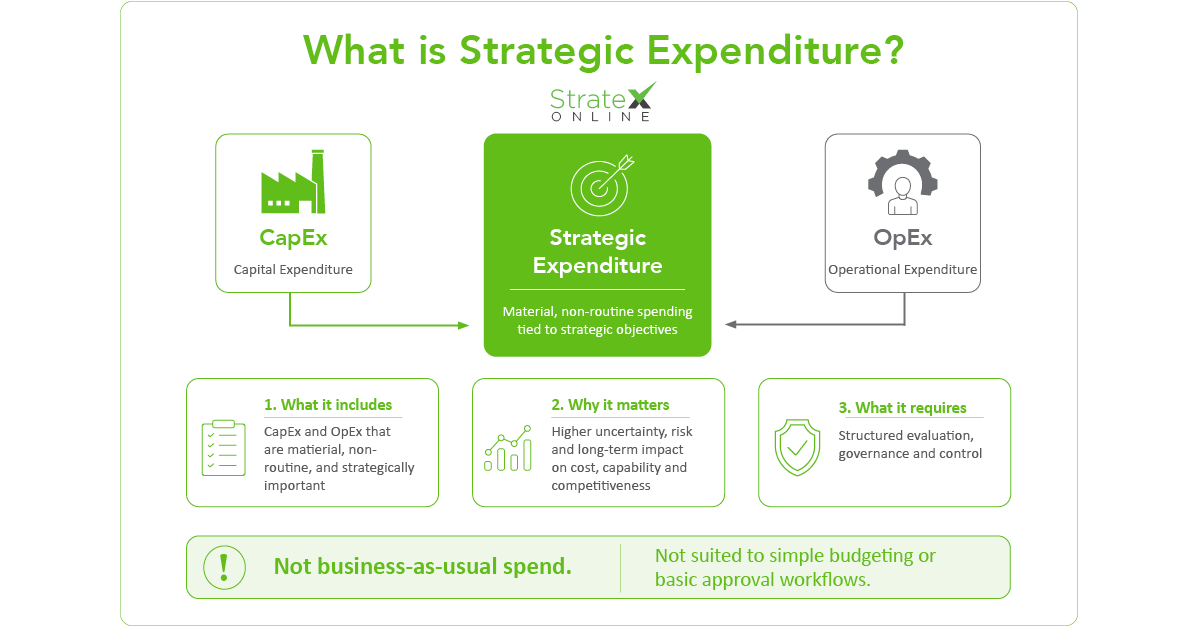
Strategic Expenditure (StratEx) refers to material, non-routine spending, across both Capital Expenditure (CapEx) and Operational Expenditure (OpEx), that is critical to achieving an organization’s strategic objectives. Managing StratEx requires more structured evaluation, governance, and control. AI projects are a relevant example of StratEx because they often span CapEx and OpEx while materially shaping long-term capability, risk, and competitive position.
Unlike business-as-usual costs, Strategic Expenditure involves higher levels of uncertainty, risk, and long-term impact. These decisions often shape cost structures, capabilities, and competitive positioning, and cannot be effectively managed through standard budgeting or simple approval workflows.
Strategic Expenditure Explained
Strategic Expenditure vs Strategic Budgeting
Strategic Expenditure and strategic budgeting are related but distinct concepts.
Strategic Budgeting

Strategic Budgeting focuses on how financial resources are allocated across the organization, typically through annual or periodic planning cycles. It defines funding levels, budget constraints, and high-level priorities across both capital expenditure (CapEx) & operational expenditure (OpEx).
Strategic Expenditure

Strategic Expenditure focuses on how individual high-impact spending decisions are evaluated, justified, and governed, regardless of whether they are classified as CapEx or OpEx.
In practice, strategic budgeting sets the constraints, while Strategic Expenditure governs the decisions made within and beyond those constraints.
| Aspect | Strategic Budgeting | Strategic Expenditure |
|---|---|---|
| Focus | Allocation of financial resources | Evaluation and governance of decisions |
| Timing | Annual or periodic planning cycles | Ongoing, event-driven decision-making |
| Scope | Budget pools and funding limits | Individual initiatives and proposals |
| Includes | Capital expenditure (CapEx) and operational expenditure (OpEx) budgets | CapEx and OpEx decisions |
| Primary Objective | Set financial boundaries and funding levels | Ensure value, alignment, and control |
| Decision Level | Portfolio or organizational level | Initiative or business case level |
| Evaluation Approach | Top-down allocation | Bottom-up evaluation and justification |
Why CapEx vs OpEx No Longer Works for Strategic Expenditure
Finance teams manage capital expenditure (CapEx) and operational expenditure (OpEx) as separate categories. While this distinction remains important for accounting and financial reporting, it is insufficient for evaluating high-impact investment decision.
The CapEx vs OpEx model creates an artificial divide between investments that are strategically interconnected. This leads to inconsistent evaluation, where similar initiatives are assessed based on classification rather than value, risk, or strategic alignment.
The Three Types of Strategic Expenditure
Strategic Expenditure spans both capital expenditure (CapEx) and operational expenditure (OpEx). In practice, it falls into three distinct types, each requiring structured evaluation, governance, and control.
Strategic Capital Expenditure (CapEx)
Strategic capital expenditure refers to high-value investments in assets, infrastructure, or projects that deliver long-term business impact.
- Large-scale capital investments
- Projects involving assets, infrastructure, or facilities
- Typically planned within capital budgets but still require rigorous evaluation
- Often linked to transformation, expansion, or capacity growth
Strategic Operational Expenditure (OpEx)
Strategic Operational Expenditure refers to high-impact operational spending that is non-routine, discretionary, and critical to business performance.
- Consulting engagements and advisory services
- AI tools, SaaS platforms, and digital capabilities
- New leased facilities, outsourcing arrangements, or operating models
- Strategic hiring or capability investments
Mixed Strategic Expenditure (CapEx & OpEx)
Many strategic initiatives combine both capital expenditure and operational expenditure, making them difficult to classify within a single category.
- Most real-world initiatives span both CapEx and OpEx
- Require coordinated evaluation across funding types
- Often involve staged or evolving investment decisions
For example, an AI implementation incorporates both:
- OpEx → software licenses, subscriptions
- CapEx → infrastructure, integration, implementation
Key Characteristics of Strategic Expenditure
Not all Capital Expenditure (CapEx) or Operational Expenditure (OpEx) is strategic. Strategic Expenditure is defined by its characteristics, not its classification. These six characteristics provide a consistent way to identify and evaluate Strategic Expenditure across different types of investment:
How to Identify Strategic Expenditure
Why Strategic Expenditure is Difficult to Manage
Strategic Expenditure is inherently more difficult to manage because it does not follow standard processes or predictable patterns.

How Strategic Expenditure Is Typically Managed
In practice, strategic expenditure is rarely managed through a single, structured process. Instead, decisions are handled across a mix of tools, conversations, and approval pathways.
- Business cases are developed in presentations or spreadsheets
- Assumptions are scattered across meeting minutes and email threads
- Decisions are localized or escalated through informal approval chains
- Supporting documentation is stored across multiple systems or not retained
The process exists, but it lacks structure, consistency, and traceability.

Why Informal Processes Create a Governance Gap in Strategic Expenditure
As the volume and complexity of strategic expenditure increases, informal processes fail to provide the structure required for consistent decision-making and control.
Approval alone does not ensure effective governance. Without a structured framework, strategic expenditure decisions become difficult to evaluate, compare, and track over time.
- Decisions are not comparable across initiatives based on consistent metrics
- Assumptions are not consistently validated, documented, or applied
- Governance depends on who is involved, not defined criteria
- Outcomes are difficult to track, review, or defend
As a result, once approved, initiatives often lose structure and visibility:
- Move into execution without formal tracking or oversight
- Become part of ongoing operational expenditure (OpEx) without visibility
- Lose connection to the original business case and assumptions
- Fail to inform organizational learning and process improvement
This creates a gap between decision-making and accountability, where high-impact expenditure is approved but not consistently governed or reviewed.
The Strategic Expenditure Management Lifecycle
The strategic expenditure process is applied across distinct stages where high-impact decisions are identified, evaluated, approved, and reviewed. The process ensures that decisions are traceable, auditable, and defensible over time.
Strategic Expenditure begins with identifying project initiatives that require evaluation.
- New ideas, opportunities, or business needs
- Demand captured across business units
- Early visibility of material CapEx and OpEx initiatives
- Initial alignment to strategic priorities
Each initiative is translated into a structured business case.
- Definition of scope, objectives, and expected outcomes
- Cost estimates across CapEx and OpEx components
- Benefits, assumptions, and supporting rationale
- Consideration of alternative options
Business Cases are assessed and compared using consistent criteria.
- Evaluation of value, risk, and strategic alignment
- Comparison across competing initiatives
- Identification of trade-offs and priorities
Initiatives are prioritized in-line with top-down capital and resourcing constraints.
- Optimize initiative selection based on constraints by area and investment driver
- Dynamically reprioritize based on changed assumptions and scenarios
- Provide improved transparency of inevitable trade-offs
- Balance initiative selection to boost success rates
Decisions are formalized through defined approval frameworks and delegation of authority (DOA).
- Structured workflows and approval processes
- Clear decision rights and accountability
- Documentation of assumptions and supporting analysis
- Full audit trail of decisions and approvals
Approved initiatives move into execution where required.
- Both CapEx and OpEx initiatives may be controlled as projects for cost control and schedule tracking
- All Strategic Expenditure will lead to contractual commitments with chosen partners
- CapEx initiatives will ultimately result in fixed asset creation and capitalization
- OpEx initiatives will lead to process change and require organizational change management
Decisions are reviewed to validate outcomes and strengthen future decision-making.
- Assessment of actual vs expected outcomes
- Review of cost, performance, and delivery
- Ongoing visibility of investment performance
- Lessons learned to inform future decisions
Why Strategic Expenditure Management Matters
- Maintains alignment between business cases and actual outcomes
- Enables consistent evaluation across CapEx and OpEx decisions
- Provides auditability through documented assumptions, approvals, and outcomes
- Ensures defensibility of investment decisions at every stage
- Strengthens accountability and visibility over time
How Stratex Online Supports Strategic Expenditure
Stratex Online applies a consistent structure to how strategic expenditure decisions are managed across the lifecycle; connecting demand, evaluation, approval, and outcomes in a single environment.
Optimizing Strategic Expenditure Decisions
- Links ideas, business cases, approvals, and outcomes in a single, structured flow
- Maintains continuity from initial proposal through to review
- Applies a consistent structure to all strategic expenditure
- Enables comparison across initiatives, regardless of classification
- Reduces reliance on fragmented tools and informal processes
- Prevents decisions from becoming disconnected or lost after approval
- Provides transparency and defensibility of the selected project portfolio
Supporting Auditability and Defensibility
- Captures the context behind each decision
- Maintains a clear record of how and why decisions were made
- Enables organizations to justify and defend investment decisions over time
Monitoring and Control
- Real-time analysis of project costs and commitments vs approved budgets
- Automatic integration to ERP and other analytic tools
Make Strategic Expenditure Decisions with Confidence
Make StratEx Decisions with Confidence
As more capital investment moves into operational models and uncertain environments, the ability to make defensible Strategic Expenditure decisions becomes critical. Get your access to a trial to see how Stratex Online enables consistent project evaluation and embedded governance across every stage of the Strategic Expenditure Management Lifecycle.
